Pages

Book Review: Vita and the Birds by Polly Crosby

Thursday, May 11, 2023


½

Thank you to NetGalley and HQ for allowing me to read this ARC!

Content Warning: violence, death, homophobia, misogyny, institutionalization.

In 1938, Vita Goldsborough seems to have it all. She's wealthy, a lady of leisure, but in their big house on the East Anglian coast, Vita's brother, Aubrey, does his best to keep her completely isolated from the outside world. But during one of her walks on the beach, Vita stumbles across an artist, sketching the seascape -- and not just any artist, but a female one. Fascinated, Vita does her best to befriend the woman -- Dodie Blakeney -- and as they grow closer, she begins to see a future for herself out from under Aubrey's thumb. In 1997, Eve Blakeney returns to the Suffolk town where she spent her summers growing up, hoping to get some closure after her mother's sudden death. But when Eve stumbles across letters written by Vita to her grandmother, she discovers a family secret that has been festering for decades -- and one that might change the course of Eve's own life.

A historical novel with family secrets and a lesbian romance? As soon as I read the premise for Vita and the Birds, I knew I had to request the ARC. I ended up reading it early, in order to get ahead on my ARCs, and as I've been having quite a stressful time in my life, I'm actually glad it was this one I chose. It's calming, somehow, in spite of the hardships that Vita and Eve are both facing, and it was easy for me to understand the ways that their calming seaside town brought peace to them in the midst of their problems. Crosby does a fantastic job of making small-town English life leap from the page, particularly when it comes to the unique building -- The Cathedral of Marshes -- that acts as the cornerstone of this book. 

Now, although it's listed as a mystery, that's not actually how I would classify Vita and the Birds. There are mystery elements, but most of them were easy for me to unravel without much help from the narrative itself, and unfortunately, some of them actually fell quite flat for me -- I'd like to go into more detail about it, but I also don't want to spoil any plot points for those who are wanting to pick this one up themselves. As a whole, the novel is more introspective, more literary and character-driven than it is a mystery. For me, that's actually not a negative, as I prefer books who focus more on characters than they do on a fast-moving plot, but some people might find it a bit disappointing. I enjoyed Crosby's simplistic, pretty writing; it fit the novel perfectly.

The characters are relatable on the surface, but I actually struggled to connect with them. I liked Vita best of them all, but Eve, Dodie, and many of the other characters remained mystifying to me, sometimes doing things that seemed out of character or somehow just not quite right. Again, I'd like to extrapolate on this more, but I don't want to spoil anything, especially as one of the problems I had with Dodie's character comes towards the end and acts as a major turning point in the plot. Now, I'm afraid I have to go on a little rant.

There's a big problem I've found continuously in lesbian romances in media. Why is there never any buildup in these romances? For straight couples, you get pages and pages and chapter and chapters of barely touching, of hesitant conversations, of unspoken feelings. You would think that in a historical novel, you would get a lot of that in a lesbian couple, but with Vita and Dodie (and many others I've read), it seems as if one moment they're meeting and talking, and the next they've suddenly fallen in love. Is it so much to ask for a slowburn? This isn't a problem unique to Crosby, but it's one that plagues fiction focusing on lesbian/wlw relationships and for me, it's a huge pet peeve.

With all of that being said, I do want to commend Crosby on the beautiful way she paints this story, and I do think I would pick up another book by her. Overall, although I didn't love it quite as much as I wanted to, I definitely would recommend this to people wanting to read a bit of a slow-burn family mystery set in a small English town!

Book Review: In Nightfall by Suzanne Young

Wednesday, March 29, 2023


½

Thank you to NetGalley and Random House Children's for allowing me to read this ARC!

Content Warning: violence, death, underage drinking.


Theo and her brother, Marco, are not excited about spending their summer in gloomy Nightfall, Oregon. After Marco throws a huge party, destroying the house and nearly getting many of his friends arrested, it's their father's idea of a punishment and visit to his mom all rolled into one. Once they arrive, however, Theo is immediately and begrudgingly charmed by the small town, and once Marco meets the beautiful, intriguing Minnow, things start to get a little more interesting for the both of them. Theo, too, is enamored by a crush of her own, but she finds their grandmother a little strange, especially with her one important house rule: never stay out after dark. When Theo is drawn into Minnow's friend group, she quickly realizes that something about the girls is -- off, somehow. And by the end of her summer trip, she might be forced to confront the dark side of Nightfall.

These days, I don't mix much with most YA books. I just don't click with it anymore, probably because I'm not exactly the intended audience anymore. Sometimes, though, you just want to pick up something fun, feel transported back to your teenage years, and for me, In Nightfall is a great example of a book that does just those things. Originally, I was intrigued by the comparisons to The Lost Boys, especially the idea that this was a sort of gender-flipped version, but beyond that shallow first impression, it manages to find its own path -- something that a lot of books with big-name comparisons can't achieve.

Theo is our main character, as we get everything from her first-person perspective, but this is really more of an ensemble type of novel, particularly when it comes to the involvement of her brother, Marco, and their family unit. She's interesting enough, and very likable, with relatable problems that many teenagers (and even adults) will be able to sympathize with. One problem I found with the entire book, however, is that most of the characters don't feel very fleshed-out, and this issue mostly plagues Theo's crush, Parrish, and the group of "wild" girls that Theo and Marco both get involved with. The two characters who assist Theo in her quest to figure out what's going on in Nightfall (and potentially help her fight any monsters who may or may not be terrorizing the town) suffer from the same problem, and I think it feels especially noticeable when they're supposed to be the Edgar and Alan of Young's book.

With that being said, Young does an excellent job of maintaining the sensation of fun and adventure, and I was really rooting for Theo and her family. Young's exploration of changing family dynamics is also spot-on, although I do wish that there had been more time to follow up with Theo's strained relationship with her mother. Another element I have to compliment is the wonderful way that Young builds up the fake town; it feels somehow genuine and authentic, with little touches and details that add a quality of realness, while also managing to keep Nightfall mysterious and just slightly off-kilter. 

What kept me from giving this four stars has to do with In Nightfall's girl gang. I was so excited to see how they would come alive on the page, but unfortunately, their allure was lukewarm for me. Truthfully, I was expecting (and hoping for) a deeper connection between Theo and the girls, especially with its comparison to The Lost Boys. In the film, it's easy to see why Michael falls under the spell of the boys, the classic tale of wanting to belong, even if it means fitting in with people who you don't truly like or get along with. Minnow, Annemarie and Beatrice are more like window-dressing, and their backstories and lives are never fully explored, something that would've made things far more interesting.

Overall, I really enjoyed this book, and I think it'll gather a lot of fans. It isn't perfect, but it's never short of fun, and it's the kind of thing you want to reread when you're feeling down.

Book Review: Big Swiss by Jen Beagin

Tuesday, March 14, 2023


Thank you to NetGalley and Scribner for allowing me to read this ARC!

Content Warning: suicide, misogyny, homophobia, rape (mentioned, off-page), eating disorders, violence, stalking, animal cruelty, racism.

Greta lives in an old Dutch farmhouse, working as a transcriber for a "sex and relationship coach" in Hudson, New York. She's also a mess. Listening in on people's therapy sessions hasn't done much for her own mental health, but she gets a kick out of it nonetheless, and she's particularly captivated by one of her boss's new clients. Greta calls her Big Swiss (owing to the fact that she's tall and from Switzerland) and for Greta, listening to her sessions is somehow cathartic -- they both have experienced major traumas in their lives, but their ways of coping are about as opposite as you can get. One day, Greta hears a familiar voice as she's at the dog park, and when she realizes it's Big Swiss in the flesh, she quickly introduces herself -- not as Greta, but Rebekah. As the two of them become tangled up in a messy, intense relationship, Greta is forced to face the demons of her past and some of the demons in her present, too.

Let me start off by saying that Big Swiss is not my usual kind of book. I decided to give it a go, mainly because I love messy female protagonists with a dark, dry sense of humor (and the lesbian relationship is a plus, too!), but I think it's only fair to mention this before I properly begin my review. Some people have likened Beagin's style to Otessa Moshfegh, and as I'm a big fan of her books, I thought, why not? It's always good to broaden your horizons. Unfortunately, in this case, I probably should've trusted the hesitation I felt. 

The biggest problem I have is with the two main characters, Greta and Flavia (the titular Big Swiss). At first, I was intrigued by their dynamic, and I even found them oddly charming in some situations, but as the novel progressed, I quickly grew tired of their flakiness, their inability to be kind to one another, and, head and shoulders above the rest, the lack of chemistry between them. It was difficult to understand why they put up with each other, and what attracted them to one another in the first place. Although the 'why' is repeatedly spelled out for us, it doesn't really make sense with the actual interactions we see on-page. Big Swiss, in particular, is not a likable or even interesting character to me. Why Greta is so instantaneously infatuated with her is really anybody's guess.

There's a lot of social commentary here, but most of it falls flat. It's the usual type of dry humor, making fun of everyone for everything, and to put it simply, it's boring. I also don't think that this book is quite as funny as it thinks it is, and instead of laughing or feeling tickled by a lot of the things intended to be funny, I was mostly left cringing. Greta is tactless, almost to the point of stupidity or naivete, and although she's forty-five, I had to continuously remind myself that she wasn't actually meant to be a vapid teenager or twenty-something. 

There's also really no plot to speak of. The ending is a bit disappointing; it feels like a lot of build-up for nothing. I didn't hate this book, but reading it felt like filler, like waiting for something meaningful to happen. Also, there's a lot of casual racism, and I wasn't a huge fan of the way the book handled Greta's questioning of her sexuality, nor did I like some of Big Swiss's comments about lesbianism (the whole "I could never be a lesbian" thing was just kind of weird).

All in all, not my cup of tea, but judging by the very high ratings this book has gotten, I might be the odd one out.

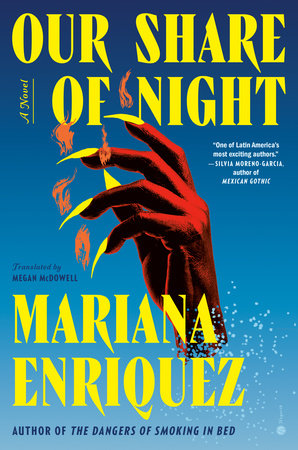
Book Review: Our Share of Night by Mariana Enriquez

Wednesday, March 8, 2023


Thank you to NetGalley and Random House for allowing me to read this ARC!

Content Warning: misogyny, violence, death, rape, racism (including slurs), child abuse, homophobia (including slurs), torture, usage of slurs against the disabled.


Juan is determined to protect his son. A powerful medium, Juan has been exploited and abused by the Order for years, beginning in his childhood, and after marrying and having a child with Rosario -- the daughter of the most powerful family of the Order -- he knows that they will do anything to get their hands on Gaspar, who they plan on using for their own ends. Fleeing across the country after Rosario's untimely death, father and son encounter obstacle after obstacle, from the brutal tactics of Argentina's military dictatorship to Juan's own dark side, a side that often comes out when he is around Gaspar. As Gaspar grows older, it becomes clear that his inheritance is inextricably tied to cruelty, magic, and ultimately, death.

Following many characters and a jumping timeline, Our Share of Night is an epic that does its best to break every storytelling convention you can think of. Written by Mariana Enriquez, an Argentine journalist and author who made it onto the shortlist for the International Booker Prize, this novel is, at its heart, an occult version of the bildungsroman. What I noticed first upon picking this up was her immense ability in creating something that sinks its claws into you. From the very first page, there's intrigue, and also a sense of impending doom, an element that pervades the story from start to finish. We begin in the head of Juan Peterson, a father who is prepared to do anything to save his son from the selfsame cult that has ruined his life. He's mourning the death of his wife, Rosario, the daughter of the wealthy Reyes Bradford family, who also happen to be the foremost leaders of the cult he's so determined to escape. His son, Gaspar, is perhaps a touch too clever for such a young child, mirroring both his rebellious father and mother in many ways.

When Juan and Gaspar are making their way across the country, the military dictatorship -- coming to power during the infamous coup where Isabel Perón was overthrown -- is in full swing. Much of this book is political, and Enriquez deals with those issues both in the form of veiled allegories and in upfront, direct lines that speak of the forced disappearances taking place, of the torture, and the so-called Dirty War tearing the country apart. Enriquez's style of speech and writing is frank, but with characteristic flair and beauty; she never shies away from the ugly, and it makes her stories that much more compelling. Her characters, too, are just as gripping, although I found Gaspar to be strangely shallow in comparison to Juan, Rosario, and the others around him. Juan, in particular, is complex, a multilayered creature that Enriquez isn't afraid of making unlikable. Somehow, against all odds, Juan is sympathetic, a testament to Enriquez's ability to create someone as flawed and interesting as a real person.

For me, this book left me with many questions, and I think that the ending, in all its strange ambiguity, was fitting. This isn't a novel you can pick up and read lightly, and at six-hundred plus pages, it's not exactly something you can breeze through. There's a weight to it, and the sometimes slow pace actually feels beneficial to what Enriquez is trying to impart. I do have a few issues with it, though. Perhaps it's simply meant to be accurate to the time period, but I really didn't like the casual use of racism and racist terms by some of the characters (including those we are supposed to like). It's peppered throughout the book a few times, and while I understand the intent of using it in a character like Mercedes, from a wealthy European family, it was strange to see the weird passage about Gaspar coloring the map and the Chinese. It was pointless, and soured my liking of the book a little. I'd be interested to see these parts in their original Spanish. My other problem is that occasionally, the storyline was just plain confusing. There's a lot of characters, a lot of timelines, a lot of places and people and problems, and every once in a while it became overwhelming.

With that being said, I loved everything else about this novel. It's gritty, fascinating, beautiful, and a wonderfully unique interpretation of cults and magic, made even better by its cultural and political aspects. In many ways, it reminds me of horror books from the '60s and '70s, and in my opinion, there's really no better comparison. 

Book Review: The Witching Hour by Anne Rice

Sunday, February 19, 2023


Content Warning: violence, death, murder, racism, misogyny, rape, incest, sexual violence, abortion, miscarriage, torture.

Rowan Mayfair is a brilliant neurosurgeon, the finest amongst her colleagues at her California hospital. Ever since childhood, however, she has been plagued by the knowledge that she is different -- and that her powers are sometimes deadly. When she saves the life of Michael Curry, drowning in the Pacific Ocean, an undeniable attraction starts between them. Michael is convinced that while he was dead, he was given a mission, one that involves returning home to New Orleans, the place he grew up. Rowan, too, has a connection to Louisiana: her adoptive mother made her promise never to go there, and never to have any contact with her family, before her death. But as fate draws Michael and Rowan closer together, they both end up back in New Orleans, and it soon becomes very clear that both of them are caught in a web much larger than they ever could have imagined. Torn between the desire to learn about her family and its history and the promise of a future away from the Mayfair Witches, Rowan will be forced to make a decision that will impact not only her, but everyone she loves.

If you've read any of the latest entries on this blog, you're probably already aware that I'm a huge Anne Rice fan. After getting back into her Vampire Chronicles books, I was also intrigued by the stories of the Mayfair Witches, often purported to be better even than the book I personally consider to be her masterpiece, Interview with the Vampire. What Rice has created in her universe of witches is truly inimitable: complex, beautiful, and above all, grotesque and horrifying. It plays much more deeply on the elements of horror than her vampire books, and speaking with perfect honesty, I now agree with the people who say that this is indeed her best.

Her writing is, as always, gorgeous, perfectly capturing the sweltering Louisiana heat, the feeling of a cultured jungle that permeates the streets of New Orleans. There's nothing quite like reading a Rice book, and somehow, The Witching Hour brings together every gothic element with true finesse. Ultimately, this is a book about family, but with a particular emphasis on matrilineal lines, on the connection between mothers and daughters. Interview with the Vampire contains these themes as well, particularly in the relationship between Louis and Claudia, but here, it is fully realized and becomes a cornerstone of every aspect of the novel.

At its center are two main characters, Rowan and Michael, but throughout a large portion, they take a backseat to the family history and the lives of past Mayfairs. For me, the historical accounts written by the Talamasca are the best parts of this book, exploring their strange powers and lives through epistolary accounts. In many ways, however, Rowan and Michael become slightly less interesting, perhaps one of my few complaints; they seem, somehow, less fleshed out than even the characters who are written about through secondhand narratives. Rowan, especially, suffers a bit from the typical Rice main character problem, being a bit too flawless to be truly likable.

Still, though, I think this book is a triumph in nearly every way. The reason I'm not giving it quite the full five stars, though, mainly has to do with the fact that some sections are painfully boring, and I couldn't quite stomach the details about Julien's life -- he's truly reprehensible, and I can't fathom how he has become a fandom favorite. Also, the racism. Jesus. If you've read other Rice books, though, you probably won't be surprised. Interview with the Vampire will remain at its five stars for me, partly due to nostalgia and partly due to the fact that it's a book I feel changed my life, despite the fact that The Witching Hour is largely superior to it. 

As a whole, I'd recommend this book, and I'm looking forward to picking up the next in this series. It's certainly something that won't be everyone's cup of tea, but The Witching Hour is a fantastic example of what gothic literature is capable of achieving. 

Book Review: After Sappho by Selby Wynn Schwartz

Tuesday, January 24, 2023


Thank you to NetGalley and W. W. Norton & Company/Liveright for allowing me to read this ARC!

Content Warning: misogyny, violence, rape, sexual harassment, racism, domestic violence, abortion, homophobia.


Following various famous lesbians during the nineteenth century as they try to capture the essence of Sappho, the Greek poet who proudly professed her love for other women, After Sappho is a series of vignettes showing both the hardship and beauty in the lives of these women -- from Romaine Brooks, the painter known for her shades of gray, to Natalie Barney, an American writer who created a literary salon in Paris that became the center of the era's lesbian community. Struggling against the crushing boot of male oppression, these women nevertheless rose to great heights, and have a special place not only in the memory of women and lesbians, but the rest of the world, too. 

First and foremost, I want to applaud Schwartz's creativity. The imaginativeness of this novel is perhaps its strongest feature -- it wouldn't be quite right to say it's totally unique (as I believe Saidiya Hartman has a similar approach), but it certainly is something you don't encounter often. It's a fascinating interplay between reality and the imagination, and Schwartz's poetic, lyrical style of writing further adds to the dreamy sensation of reading it. Even in this day and age, where there is much more freedom in the exploration of gender and sexuality, many young lesbians will relate to the fervent desire of these women to explore a shared history, a connected past. It's not lost on me that while these women were reading tomes about Sappho, translating her poems from their original Greek, we are reading about them as they were doing it.

Many of the women included here are well-known, and have had much written about them. Virginia Woolf, for example, is featured heavily here, as is her lover, Vita Sackville-West, as is Natalie Barney, Romaine Brooks, Radclyffe Hall, Sarah Bernhardt, and many others. It would be remiss not to include them in some capacity, anyway -- they are responsible for influencing modern art and literature in so many ways, not to mention the lesbian community. There are a few others that I hadn't heard of previously, namely Sibilla Aleramo, one of the first openly feminist writers in Italy, as well as Lina Poletti, one of the first women to declare herself a lesbian in Italy. My only major complaint here is that, in some ways, I wish Schwartz had focused on lesser known lives. We have a wealth of information already on these women; wouldn't some of the ones we know less about have been particularly exciting to expand upon?

Josephine Baker and Ada "Bricktop" Smith are also briefly mentioned, but there's barely any time given to them at all. It made me question, speaking truthfully, why they were included at all. It felt as if they were namedropped, and that was it. I do understand, to some degree, why this is: Schwartz is focusing specifically on the set of women who are slightly interwoven with one another during this period, but still, what was the point of very briefly mentioning Ada and Josephine just to completely leave them out later?

As a whole, the book suffers from a sense of being somewhat disjointed. Because of the stylistic choice Schwartz makes, none of these women ever feel truly fleshed out, and the brevity of each section leaves you wishing that a bit more time had been spent on them. 

All in all, I don't think that this is a completely successful venture, but I do applaud Schwartz's creativity and ambition. I'll be interested to see what her next novel holds!

Book Review: Spear by Nicola Griffith

Sunday, January 1, 2023


Content Warning: violence, death, non-graphic mentions of sexual violence.


Growing up in the wild, Peretur lives in a cave with her mother. She knows that there's something special about herself and her lineage, but her mother is secretive, clearly fearful of revealing too much. When she comes to learn of the court at Caer Leon, its knights, and its king, Arturus, Peretur senses that her destiny lies there -- and that, perhaps, she will discover why she has visions of a faraway lake, which she feels is somehow connected. As she fights bandits with nothing but her broken hunting spear, trying to make a name for herself in order to one day join the knights of Caer Leon, Peretur discovers just who she is -- and what the future holds for her.

Although this book is only around 180 pages, it is so remarkable and packs such a punch that I'm still thinking about it days later. As soon as you read the first page, you're consumed by the beautiful world that Griffith paints with her sublime prose, and our heroine, Peretur, is immediately engaging. This is a retelling of Sir Percival and his search for the Holy Grail, but in a world populated by retellings of King Arthur's court, Griffith pulls off no small feat in making it feel like it's uniquely her own. 

It's hard to explain Peretur. She's tough, compassionate, complex, a kind, gentle stealer of women's hearts, a knight in the making. She's a little strange, too, in ways that make her instantly likable and relatable, and it's easy to see yourself in her as she struggles to fit in and find the place where she belongs. This story is primarily about homecoming, and what the word 'home' means. Sometimes home is not where you've grown up, not where you currently find yourself, but a place in the future, a group of people, a warm conversation with someone you love. In the author's note at the end, Griffith expands on this a little as she discusses Peretur's "Hero's Journey," and how for her, becoming a hero is not about finding power, but about finding out who she is and how she fits into the world.

There's not much focus on King Arthur or Guinevere, which, odd though it may sound, I actually liked. Not to say that they aren't an (obviously) important part of the story, but our focus remains squarely on Peretur, and she is never overshadowed by the more well-known figures from myth. Her dynamic with Nimue is warm and fascinating, and I liked her banter and complex relationships with the other Knights of the Round Table. It's a cliched phrase, but I truly mean it when I say that Griffith has managed to breathe fresh life into a story that has been circulating for centuries.

Peretur's relationship with her sexuality and gender is beautiful, and I love that, for the most part, it's totally uncomplicated. She is an unapologetic lesbian, and there is never any doubt in her as to her love for women, or how it impacts her life. I liked, too, that though she obviously identifies with being a woman, she finds herself in that place that many lesbians do: the ways she conforms to her gender, and the ways she does not, is complicated, individual to her, and beautifully explored in her knighthood. It's hard to do it justice just talking about it here -- I could never explain it in the myriad lovely ways that Griffith does -- but just trust me!

Highly recommended, especially to fans of Arthur's court who are looking for something a little different and new. 

 
FREE BLOGGER TEMPLATE BY DESIGNER BLOGS