Pages

Book Review: The Witching Hour by Anne Rice

Sunday, February 19, 2023


Content Warning: violence, death, murder, racism, misogyny, rape, incest, sexual violence, abortion, miscarriage, torture.

Rowan Mayfair is a brilliant neurosurgeon, the finest amongst her colleagues at her California hospital. Ever since childhood, however, she has been plagued by the knowledge that she is different -- and that her powers are sometimes deadly. When she saves the life of Michael Curry, drowning in the Pacific Ocean, an undeniable attraction starts between them. Michael is convinced that while he was dead, he was given a mission, one that involves returning home to New Orleans, the place he grew up. Rowan, too, has a connection to Louisiana: her adoptive mother made her promise never to go there, and never to have any contact with her family, before her death. But as fate draws Michael and Rowan closer together, they both end up back in New Orleans, and it soon becomes very clear that both of them are caught in a web much larger than they ever could have imagined. Torn between the desire to learn about her family and its history and the promise of a future away from the Mayfair Witches, Rowan will be forced to make a decision that will impact not only her, but everyone she loves.

If you've read any of the latest entries on this blog, you're probably already aware that I'm a huge Anne Rice fan. After getting back into her Vampire Chronicles books, I was also intrigued by the stories of the Mayfair Witches, often purported to be better even than the book I personally consider to be her masterpiece, Interview with the Vampire. What Rice has created in her universe of witches is truly inimitable: complex, beautiful, and above all, grotesque and horrifying. It plays much more deeply on the elements of horror than her vampire books, and speaking with perfect honesty, I now agree with the people who say that this is indeed her best.

Her writing is, as always, gorgeous, perfectly capturing the sweltering Louisiana heat, the feeling of a cultured jungle that permeates the streets of New Orleans. There's nothing quite like reading a Rice book, and somehow, The Witching Hour brings together every gothic element with true finesse. Ultimately, this is a book about family, but with a particular emphasis on matrilineal lines, on the connection between mothers and daughters. Interview with the Vampire contains these themes as well, particularly in the relationship between Louis and Claudia, but here, it is fully realized and becomes a cornerstone of every aspect of the novel.

At its center are two main characters, Rowan and Michael, but throughout a large portion, they take a backseat to the family history and the lives of past Mayfairs. For me, the historical accounts written by the Talamasca are the best parts of this book, exploring their strange powers and lives through epistolary accounts. In many ways, however, Rowan and Michael become slightly less interesting, perhaps one of my few complaints; they seem, somehow, less fleshed out than even the characters who are written about through secondhand narratives. Rowan, especially, suffers a bit from the typical Rice main character problem, being a bit too flawless to be truly likable.

Still, though, I think this book is a triumph in nearly every way. The reason I'm not giving it quite the full five stars, though, mainly has to do with the fact that some sections are painfully boring, and I couldn't quite stomach the details about Julien's life -- he's truly reprehensible, and I can't fathom how he has become a fandom favorite. Also, the racism. Jesus. If you've read other Rice books, though, you probably won't be surprised. Interview with the Vampire will remain at its five stars for me, partly due to nostalgia and partly due to the fact that it's a book I feel changed my life, despite the fact that The Witching Hour is largely superior to it. 

As a whole, I'd recommend this book, and I'm looking forward to picking up the next in this series. It's certainly something that won't be everyone's cup of tea, but The Witching Hour is a fantastic example of what gothic literature is capable of achieving. 

Book Review: After Sappho by Selby Wynn Schwartz

Tuesday, January 24, 2023


Thank you to NetGalley and W. W. Norton & Company/Liveright for allowing me to read this ARC!

Content Warning: misogyny, violence, rape, sexual harassment, racism, domestic violence, abortion, homophobia.


Following various famous lesbians during the nineteenth century as they try to capture the essence of Sappho, the Greek poet who proudly professed her love for other women, After Sappho is a series of vignettes showing both the hardship and beauty in the lives of these women -- from Romaine Brooks, the painter known for her shades of gray, to Natalie Barney, an American writer who created a literary salon in Paris that became the center of the era's lesbian community. Struggling against the crushing boot of male oppression, these women nevertheless rose to great heights, and have a special place not only in the memory of women and lesbians, but the rest of the world, too. 

First and foremost, I want to applaud Schwartz's creativity. The imaginativeness of this novel is perhaps its strongest feature -- it wouldn't be quite right to say it's totally unique (as I believe Saidiya Hartman has a similar approach), but it certainly is something you don't encounter often. It's a fascinating interplay between reality and the imagination, and Schwartz's poetic, lyrical style of writing further adds to the dreamy sensation of reading it. Even in this day and age, where there is much more freedom in the exploration of gender and sexuality, many young lesbians will relate to the fervent desire of these women to explore a shared history, a connected past. It's not lost on me that while these women were reading tomes about Sappho, translating her poems from their original Greek, we are reading about them as they were doing it.

Many of the women included here are well-known, and have had much written about them. Virginia Woolf, for example, is featured heavily here, as is her lover, Vita Sackville-West, as is Natalie Barney, Romaine Brooks, Radclyffe Hall, Sarah Bernhardt, and many others. It would be remiss not to include them in some capacity, anyway -- they are responsible for influencing modern art and literature in so many ways, not to mention the lesbian community. There are a few others that I hadn't heard of previously, namely Sibilla Aleramo, one of the first openly feminist writers in Italy, as well as Lina Poletti, one of the first women to declare herself a lesbian in Italy. My only major complaint here is that, in some ways, I wish Schwartz had focused on lesser known lives. We have a wealth of information already on these women; wouldn't some of the ones we know less about have been particularly exciting to expand upon?

Josephine Baker and Ada "Bricktop" Smith are also briefly mentioned, but there's barely any time given to them at all. It made me question, speaking truthfully, why they were included at all. It felt as if they were namedropped, and that was it. I do understand, to some degree, why this is: Schwartz is focusing specifically on the set of women who are slightly interwoven with one another during this period, but still, what was the point of very briefly mentioning Ada and Josephine just to completely leave them out later?

As a whole, the book suffers from a sense of being somewhat disjointed. Because of the stylistic choice Schwartz makes, none of these women ever feel truly fleshed out, and the brevity of each section leaves you wishing that a bit more time had been spent on them. 

All in all, I don't think that this is a completely successful venture, but I do applaud Schwartz's creativity and ambition. I'll be interested to see what her next novel holds!

Book Review: Spear by Nicola Griffith

Sunday, January 1, 2023


Content Warning: violence, death, non-graphic mentions of sexual violence.


Growing up in the wild, Peretur lives in a cave with her mother. She knows that there's something special about herself and her lineage, but her mother is secretive, clearly fearful of revealing too much. When she comes to learn of the court at Caer Leon, its knights, and its king, Arturus, Peretur senses that her destiny lies there -- and that, perhaps, she will discover why she has visions of a faraway lake, which she feels is somehow connected. As she fights bandits with nothing but her broken hunting spear, trying to make a name for herself in order to one day join the knights of Caer Leon, Peretur discovers just who she is -- and what the future holds for her.

Although this book is only around 180 pages, it is so remarkable and packs such a punch that I'm still thinking about it days later. As soon as you read the first page, you're consumed by the beautiful world that Griffith paints with her sublime prose, and our heroine, Peretur, is immediately engaging. This is a retelling of Sir Percival and his search for the Holy Grail, but in a world populated by retellings of King Arthur's court, Griffith pulls off no small feat in making it feel like it's uniquely her own. 

It's hard to explain Peretur. She's tough, compassionate, complex, a kind, gentle stealer of women's hearts, a knight in the making. She's a little strange, too, in ways that make her instantly likable and relatable, and it's easy to see yourself in her as she struggles to fit in and find the place where she belongs. This story is primarily about homecoming, and what the word 'home' means. Sometimes home is not where you've grown up, not where you currently find yourself, but a place in the future, a group of people, a warm conversation with someone you love. In the author's note at the end, Griffith expands on this a little as she discusses Peretur's "Hero's Journey," and how for her, becoming a hero is not about finding power, but about finding out who she is and how she fits into the world.

There's not much focus on King Arthur or Guinevere, which, odd though it may sound, I actually liked. Not to say that they aren't an (obviously) important part of the story, but our focus remains squarely on Peretur, and she is never overshadowed by the more well-known figures from myth. Her dynamic with Nimue is warm and fascinating, and I liked her banter and complex relationships with the other Knights of the Round Table. It's a cliched phrase, but I truly mean it when I say that Griffith has managed to breathe fresh life into a story that has been circulating for centuries.

Peretur's relationship with her sexuality and gender is beautiful, and I love that, for the most part, it's totally uncomplicated. She is an unapologetic lesbian, and there is never any doubt in her as to her love for women, or how it impacts her life. I liked, too, that though she obviously identifies with being a woman, she finds herself in that place that many lesbians do: the ways she conforms to her gender, and the ways she does not, is complicated, individual to her, and beautifully explored in her knighthood. It's hard to do it justice just talking about it here -- I could never explain it in the myriad lovely ways that Griffith does -- but just trust me!

Highly recommended, especially to fans of Arthur's court who are looking for something a little different and new. 

Book Review: Shadows of Pecan Hollow by Caroline Frost

Sunday, December 18, 2022


Content Warning: death, violence, murder, rape, sexual harassment, abuse (emotional, physical, sexual, domestic and including that of a child), pedophilia, grooming, animal death, abandonment, abortion, animal cruelty.


Kit Walker has spent the last fourteen years trying to forget her past. Once a part of the infamous "Texaco Twosome," robbing gas stations and conning everyone she meets alongside her caretaker, lover, and abuser, Manny Romero, she's decided to put it all behind her -- mostly because she is trying to be a good mother to her daughter, Charlie. But when Manny shows up, fresh out of prison and apparently eager to right his wrongs, Kit and Charlie are both thrown into a tailspin. Torn between the past and the future, Kit must come to terms with everything she's done and all that has been done to her, with consequences that will impact not only her and her daughter, but the entire town of Pecan Hollow.

Though this is Frost's debut, Shadows of Pecan Hollow often has a quality to it that is suggestive of a much more experienced author. This is not an easy book to read by any stretch of the imagination (pretty much any dark, heavy topic you can think of is covered here), but Frost does it with a quiet, human touch that explores both the darkest sides of humanity, and the more hopeful ones, too. 

Our heroine is Kit Walker: hard as nails, desperately trying to make a new life for herself and her daughter, and struggling with the weight of her past. For me, Kit was immediately likable, mostly because she is complex, flawed, and human. She's been in and out of foster homes her whole life, hurt by the people who are supposed to be the ones to love and care for her, and her righteous anger at the world is searing and realistic in its depiction. As you read on, it's easy to understand why Kit struggles to connect with others, why she is always prepared for people to do their worst. She's sympathetic, and because her character is so strong, it makes the story compulsively readable.

Her daughter, Charlie, is also a wonderful character, rather fully fleshed out in spite of the fact that we only get a few chapters with her narration. It's Manny, Kit's partner in crime and Charlie's father, who rounds out the cast. He works as a perfect foil for Kit. He's cruel and narcissistic, but it isn't difficult to see why Kit was and is so disarmed by him. Snaking his way into the hearts of others and taking advantage of them is simply second-nature to him.

The story itself is decent, primarily character-driven, something I personally enjoy. There are parts where it gets a bit sluggish, though, and I think that there's honestly a lot that could've been cut or pared down. Some of the writing, too, feels a bit clumsy, partnered with a few grammatical errors as well. These aren't particularly large issues, but they did impact my enjoyment somewhat. 

All in all, I'd recommend it - I think Frost does a masterful job of showing the aftereffects of lifelong abuse, and despite all the darkness in Shadows of Pecan Hollow, there's beauty, hope, and forgiveness, too.

Book Review: In the Cut by Susanna Moore

Wednesday, December 7, 2022


Content Warning: death, violence, murder, rape, sexual harassment, racism (including racial slurs), homophobia (including homophobic slurs), misogyny.


Frannie is a teacher. Her days are spent educating college-aged youths about language, its usages, writing, and the virtues of slang. In most respects, her life is ordinary -- she's divorced, single, and when she's not teaching, she dedicates herself to creating a dictionary of street slang. One night, Frannie is out at a bar, and sees something she isn't supposed to: an intimate moment between a man and a woman. Shaken and strangely enthralled, her world is turned upside down as a vicious serial killer stalks the streets of her neighborhood, and as she grows closer to one of the police officers working the case, Frannie realizes that the murders might be even closer to home than she thinks.

Adapted into a film that, at the time, was reviled by critics, In the Cut is an unapologetic look into gender-based violence, women's sexuality, and the often painful intersection of the two. At the time of its publication in 1995, it was considered slightly shocking, perhaps not so much because of its graphic sex scenes, but because of its frank and brutal insight into patriarchy. It's been on my list for a long time; I learned of the book first, and then later, saw bits and pieces of the film, enough to intrigue me to pick it up. Having finally gotten around to it, I'm left with mixed feelings on both its message and its impact.

To begin with, our protagonist, Frannie, is interesting. We're having a bit of an unlikable female character revolution right now -- the books of Moshfegh, Taddeo and Flynn come to mind -- and I think Frannie fits nicely into the category, although she might be considered more sympathetic than many of the darker, crueler characters who populate it. In spite of the dark, occasionally violent desires she harbors (mainly with regards to sex and men), she refreshingly exists somewhere between the Madonna/Whore dichotomy, prone both to prudishness and candor. Her romantic interest (if he can be called that) is Detective Malloy, a figure who represents the unsavory aspects of herself that Frannie seeks to suppress. 

Malloy is both Frannie's mirror and her opposite: she, in her austerity, is attracted to his crude and vulgar way of speaking and acting. With him, she opens up to a side of herself that she wasn't aware existed in the first place. Truthfully, that's about as far as I'm able to understand why Frannie keeps coming back to him -- it doesn't shock me that a woman might keep returning to man who is brutish or provides a way for her to self-destruct, but it's his casual homophobia, sexism and racism that makes it baffling to me. It's interesting: Frannie thinks of herself as a feminist, someone openminded, and yet she never makes any effort either to question or challenge Malloy's biases. I'm not really sure why Moore felt the need to include it, let alone allow it to pass by without any introspection from Frannie.

Frannie's most interesting relationship is actually with Cornelius, one of her students, a young Black man who has a fascinating and complex way of using language that draws Frannie in. He ends up being underutilized; I often questioned why he was included in the first place, since in the end, he's brushed off without much fanfare. Her friendship with Pauline, too, is intriguing -- I wished there was a bit more of her, this woman who "dates married men because she wants to be alone on the holidays."

As for Moore's unraveling of patriarchal desire (and how women are dictated by men in every aspect of their lives), I thought it was good, but perhaps not as revelatory as it must've been in '95. Nonetheless, I think many feminists will find it to be a thought-provoking piece of literature, and I particularly enjoyed the way that Moore combines the erotic with the violent, the sexual with the grotesque. These things go hand-in-hand more often than we'd like to admit, and Moore excels at making her story engrossing in its repulsiveness. 

Would I recommend it? That's a tough one. Once again, if you're interested in feminist literature, I think it's worth a go (especially when it comes to the misogyny of the '90s), but overall, there was something a touch unsatisfying about it. The strangely unchallenged racism, which I personally don't think Moore was equipped to handle in a fulfilling way, is the main reason why this book couldn't rise above the three star mark for me.

Book Review: Breathless by Amy McCulloch

Tuesday, December 6, 2022


Content Warning: death, violence, sexual harassment, misogyny.


Cecily Wong is about to get the interview opportunity of a lifetime. She's been handpicked by Charles McVeigh, a famous mountaineer known for climbing alpine style, to write an article about him as a part of his mission to summit all fourteen of the eighteen-thousand meter mountain peaks in the world. But there's one condition: McVeigh won't allow her to interview him until after she summits Manaslu with the rest of his team. Known for its avalanches, dangerous terrain, and unpredictable climate, Manaslu is a challenge that Cecily isn't sure she's ready for -- but with the place she's in at work and financially, she can't say no. Before they're even at camp two, strange deaths start occurring, written off as misadventures caused by hypoxia. Cecily, though, isn't so convinced -- and as she gets higher and higher on the mountain, she soon begins to realize that a murderer might be stalking them as they make the summit push.

I've always been interested in mountaineers. The dangers they face, the extensive preparation they must do both on and off the mountain, the question of what it is that drives people to put their lives at risk. I've never read a book revolving around a mountaineering expedition before, so I was intrigued when I first heard about it, and I was also pleased by the fact that the main character is a biracial woman, half-Chinese and half-white (I feel that, by and large, most thrillers are populated with only white heroes and heroines).

Unfortunately, Breathless did not manage to meet my expectations. It's not the worst thing I've ever read, but there's a lot it lacks -- the writing, for example, is decent, but feels slightly juvenile, perhaps because this is McCulloch's first foray into writing an adult book (all of her others have been middle-grade). I could overlook the simplistic, slightly boring writing style, but what I can't overlook is how boring this book actually is in practice. The concept sounds appropriately thrilling, but the majority of the book -- more than half of it, I'd say -- mainly involves Cecily going back and forth over whether or not she'll be able to summit, and rather uninteresting conversations with the rest of the cast, who come off as shallowly as Cecily does. 

The summit push doesn't even come until around the 90% mark; the rest feels like little more than filler. The deaths could be intriguing, but they feel, strangely enough, as if they're little more than decoration. Suspense doesn't really come into it, at least not until the very end. I would be remiss not to mention that Cecily continuously makes such such stupid, poorly thought out decisions that it was hard to root for her at all. Her naïveté is, frankly, astounding. She brushes so much off simply because she likes the people involved, or thinks they seem courageous or interesting. She almost seems to possess no journalistic sense of curiosity or skepticism whatsoever.

All in all, I wouldn't recommend this, particularly to people who are already big fans of the suspense/thriller/mystery genres. 

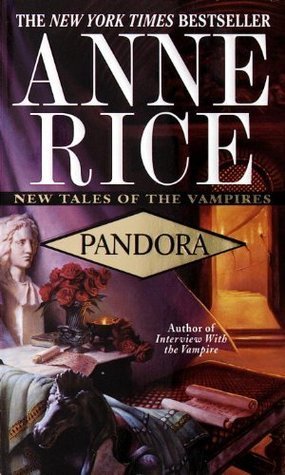
Book Review: Pandora by Anne Rice

Sunday, December 4, 2022


Content Warning: pedophilia, grooming, death, violence.

Born in Caesar Augustus's Rome, Pandora grows up with an adoring father who is a Senator, and is educated freely as many women of her time. She is ten years old when she first meets the then-mortal Marius, an encounter that will irreversibly alter her fate. Now, in a café in 1990s Paris, Pandora meets David Talbot, who is eager for her to finally tell her story in her own words.

Pandora is a fascinating, complex figure in Rice's world of vampires. Although she has been criminally underdeveloped, she has the promise of a truly interesting backstory, one of the vampires from the ancient world. Although her character is, obviously, more expanded here, I had the odd feeling the entire time that she was still acting as little more than window-dressing for the complex backgrounds and characters of the men in this series.

Although she's a young woman in one of the most fascinating times and places on earth, Rice mostly glosses over this section of her life. There's a bit of intrigue when she is a little girl, with discussions of Ovid and some of Augustus's court politics, but it never becomes fully fleshed out. Her affiliation with the temple of Isis is another interesting element, but again, it somehow feels almost... boring, or perfunctory. I love how the legend of Isis ties in with Akasha and Enkil; that's probably my favorite part of this book. But as a whole, it's disjointed, a little awkward and fumbling.

I was also disappointed by how few other characters play a part in Pandora's life. Once again, we are stuck with Marius, who is as creepy and inappropriate in this book as he is in all the others, and for the millionth time, I found myself questioning why Rice was so keen to make him such a central figure. His complicated, rather fiery relationship with Pandora is interesting enough, but their first meeting -- when she is a little girl and he is a man of twenty-five -- is uncomfortable, strange, and leaves a distasteful film over the rest of the novel. I won't go into too much discussion of it here, as I've already mentioned it several times previously in my other reviews, but regardless, it negatively impacted my opinion yet again.

The worst part is that through it all, Pandora still feels underdeveloped. She's intelligent, beautiful, and spirited, but really, that's about it. Her innerworkings come across as simple, especially when compared to others in the series. That being said, the portion of the book that takes place in Antioch paints a wonderfully fascinating picture of that ancient place, and I loved her interactions with Flavius, an Athenian slave who has a beautiful, gentle relationship with her. It wasn't awful by any stretch of the imagination, but it certainly isn't the greatest Rice I've ever read.

Recommended if you are interested in Pandora, or some of the lesser known characters in the Chronicles.

 
FREE BLOGGER TEMPLATE BY DESIGNER BLOGS