Book Review: House of Hunger by Alexis Henderson
Tuesday, September 27, 2022
Tuesday, September 20, 2022
Monday, September 19, 2022
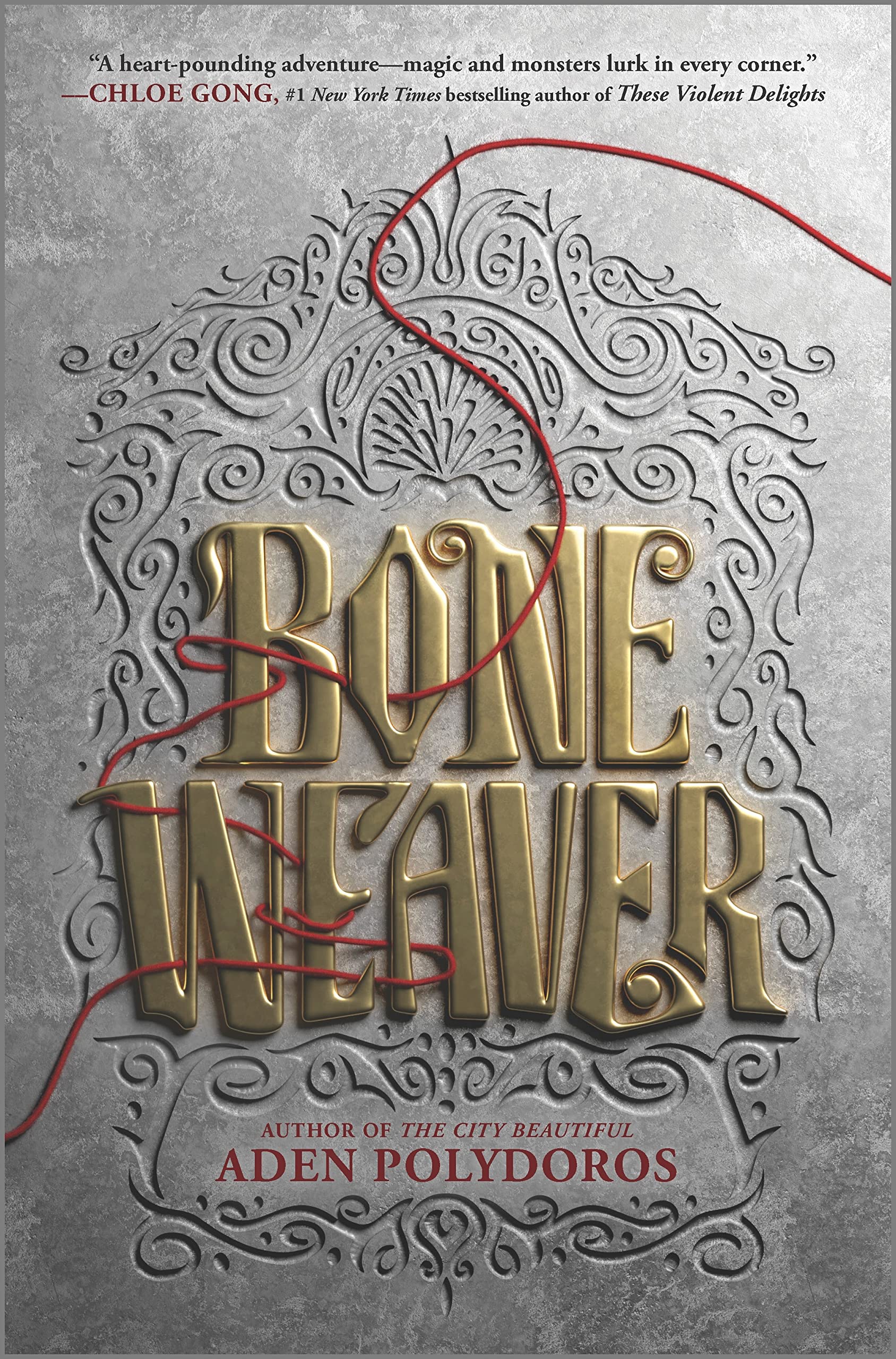
Seventeen-year-old Toma lives in the wilderness of the vast Kosa empire. Although the empire is turning in on itself, in the midst of a deadly revolution, Toma is unaware of the political tensions and ongoing civil war, having not been amongst other humans in years. Suddenly, the unrest is brought to Toma and her adoptive upyri family's doorstep with the crashing of an airship, holding only two passengers -- and one of them is Tsar Mikhail himself. Forced by disaster into a mission of her own, Toma accompanies Mikhail on his journey to destroy Koschei, the leader of the anti-Tsarist revolutionaries, picking up another straggler, Vanya, on their way. As the trio grows closer, Toma will be forced to confront her past and, even more frighteningly, her future -- and all three of them will learn that true monsters don't wear their wickedness on the outside.
Finally, a book from my list of most highly anticipated 2022 reads that didn't disappoint! Bone Weaver is everything I could ask for in a Russian and Slavic inspired fantasy, replete with folklore and monsters, all while addressing the proletariat revolution and the faults of its fantasy empire.
To start off, this book is simply full of monsters. Something that often bothers me when I pick up a fantasy book is that while it proclaims to have pages full of monsters and folklore, they seem little more than window-dressing. That's never the case in Bone Weaver: there are rusalki, mavki, upyri, and more, all written about with an admiration for their haunting, sometimes frightening, beauty. It's obvious from the first page that Polydoros loves writing about these creatures, and although this obviously deals with much more mature subject matter, it reminded me a bit of reading The Spiderwick Chronicles -- and what more could I ask for then that?
As for the characters, all of them are lovable, even when they are not nice or friendly or on their best behavior. Toma, of course, is my favorite, and she operates as the kind of heroine that is naive but not obnoxious (which is hard to do; instead, her naivete feels endearing). Her companions, Mikhail and Vanya, are equally wonderful, although I will say that it took me a while to warm up to Mikhail. Perhaps it's because I'm a bit biased, but I wasn't sure that I would buy into his rehabilitation, into the narrative that he will truly fight for change in his empire. By the end, however, I greatly enjoyed Mikhail's character, and even ended up rooting for him (which took me by surprise). He still wasn't quite on the level of Toma or Vanya for me, but nonetheless, I think that Polydoros did an incredible job crafting every single character we encounter on the page.
The worldbuilding has real depth to it. One of my favorite things in fantasy books is that feeling you get that, just beyond the page, there's a whole world out there -- real and fully fleshed out -- that we've yet to see. I never, ever say this, but I almost wish that Bone Weaver had been the first in a series. It feels as if there's so much more to explore, even with regards to Toma's background, for example, or Vanya's. My only real complaint about this book is that it simplifies the revolution, and in turn, simplifies its (amazing) villain. However, this is YA fantasy, so I don't mind it being boiled down to basics -- and that isn't to say that there isn't complexity or nuance in this book because there's plenty.
Highly, highly recommended. This is, without a doubt, the best Russian and Slavic inspired fantasy I've ever had the pleasure of reading.
Saturday, September 3, 2022
Tuesday, August 23, 2022
Monday, August 15, 2022
After the prophecy that has named her the rightful Empress of Parijatdvipa, Malini is well on her way to deposing her cruel brother. Although she anticipates being defied at every turn, her newly-appointed status as a ruler chosen by the gods has left her more open than ever to criticism and hardship. Meanwhile, Ahiranya has finally found its freedom from imperial oppression, and Priya has risen fully to her position as an Elder. The magic that flows through her body, however, is changing -- and Priya is no longer sure if she knows what she's capable of. As the war rages on, Malini realizes that she needs Priya -- her secret weapon -- and against all odds, they find themselves together once more... but will their reunion end in happiness, or destruction?
I don't read many series these days, but after I finished The Jasmine Throne, I was so happy to find out that it was going to be a trilogy. Not only did I instantly fall in love with our two heroines, Priya and Malini, but I was also captivated by the magic system and the gorgeous world Suri has created. So, does the sequel live up to the amazing potential captured in the first book?
In my opinion, yes. We are once again following Malini and Priya, as well as several other characters introduced in the first book (including Bhumika, who I simply adore), and it felt like coming home to jump into their shoes again. Now, they're contending with even bigger problems than they were before, Priya with her new role as an Elder (a role that she isn't quite sure how to embrace) and Malini with keeping the faith she's engendered in her new followers. This book is much bigger than just Malini and Priya, though, and I felt like there was more of a focus on what's happening outside of them this time around.
The Jasmine Throne got some criticism for its many POVs, and, if anything, I did feel that this problem is not fixed -- if anything, it felt as if there were even more perspectives and characters to contend with. For me, it's not a problem, but I think that some people will struggle with it. There were moments where I wondered why, exactly, we were getting a certain character's perspective, or following a particular storyline, as it seemed to add nothing overall to either the plot or pacing. I'm also confused as to why, instead of allowing us to enter into the head of Varsha, Chandra's new wife, we are given the POV of her brother. I think it would have been more interesting (and fitting) to let us see the world and her marriage through her eyes.
Those are my main complaints; otherwise, I was just as enchanted by this entry into the series as the first. The moments between Malini and Priya were beautiful, and truly made the novel shine. I also love Bhumika, and you really get the chance to fall for her in this book.
While it wasn't perfect (like I thought The Jasmine Throne was), this is a solid second book, and I'm excited (and scared!) for the final installment.
Wednesday, August 3, 2022
In medieval Moldova, Elina and Mira live totally separate lives. Elina is the wealthy daughter of a boyar, the aristocratic class that employ serfs and slaves, while Mira is a simple potter's daughter, used to going without a meal and trying to fight off the cold. But when the two are inadvertently brought together, there's an immediate spark between them, and they begin to realize that, as women, their stations in life might not be so different after all. As they come to terms with their feelings for one another, Mira and Elina both will have to make the ultimate sacrifice to achieve freedom -- and the possibility of spending their lives together.
Doesn't the premise for this book sound so great? Medieval Moldova is not a time nor place I've ever seen in another book, and it's a culture I'm not overly familiar with. Even more fascinating, the central relationship is between two women, and Set in Stone tackles many issues (some which we are, sadly, still facing today) over the course of Mira and Elina's journey. It saddens me to say I'm not able to give more than three stars here, though. For me, there were too many problems to bump this up to a full four stars. With that being said, let's delve into what worked for me, and what didn't.
Firstly, Brinzeanu's writing style didn't click for me. It was a little too dry for my tastes, and when it wasn't, the similes felt strangely overwrought. There was more telling than showing, which grew a bit irritating over time. I wanted to actually feel as if I was experiencing the scenes, instead of being told of it secondhand. This problem persists throughout the novel, although I will say that the longer I read, the more acclimated to the style I became.
Sadly, the characterization also struck me as a touch shallow. While I ended up loving both Elina and Mira, it took quite a while for it to actually feel as if you're seeing the events and emotions through their eyes. I also found the abrupt beginning to their relationship not only strangely paced, but I struggled with whether or not it made sense for young women of this time period and place. Personally speaking, I'm a huge fan of slow-burns, and I think there was more than enough time to work up to their relationship, and deepen it in the process.
That being said, I did root for both of them, separately and together, and this book offers a beautiful (and harrowing) insight into Moldavian culture, religion, class, and, of course, the lives of Moldavian women. There are some beautiful moments, suffused with nature magic and the tenderness of love, but once again, the writing style kept you at such a distance that it was sometimes hard to admire them fully.
One of my other issues concerns a (very one-dimensional) side character, Dafina. Dafina is a Romani slave, and in the brief instances where she interacts with Elina, she comes off as stereotypically "mysterious," reading palms and telling fortunes. Had she been more developed, it might've not been an issue, but otherwise, she serves little narrative purpose -- well, she does serve a purpose, but it would be a huge spoiler to say how. Let's just say that the purpose is to further Elina's journey, and otherwise, Dafina is just a walking stereotype, there to make cryptic comments and save Elina's hide. The slur commonly used against Romani people is also frequently found in this book. As I'm not Romani myself, I can't say whether or not this is offensive in its historical usage (considering Set in Stone takes place in the Middle Ages). I would love some input on this; all I'll say for now is be forewarned, and it did make me uncomfortable when I was reading it.
Overall, I did like Set in Stone, but nothing about it blew me away. I'm not sure it's the kind of book that will stick with me for very long. If you're interested in the culture and the time period, I'd definitely say give it a shot, but as it stands, for me, this felt more like reading a screenplay. I will consider picking up whatever Brinzeanu writes next, however, as I imagine her second novel will improve upon the issues I've mentioned here!